
For a Maui rental car, do not assume your credit card, debit card, travel insurance, or personal auto policy automatically solves the insurance question. Start with the rental company’s requirements, then confirm what your own policy and card benefits actually cover. At Aloha Rent A Car, renters must bring proof of full-coverage insurance, such as a declaration page or insurance card, and a valid major credit card in the renter’s own name. Debit cards are not accepted, and if you have no car insurance, Aloha cannot rent to you.
Before you check availability for your Maui dates, decide who the renter is, confirm that person’s insurance proof, and review the current Aloha Rent A Car rental policies. That is much easier than trying to solve coverage questions after landing at Kahului Airport with luggage waiting.
Start with what the rental company requires
Rental car insurance gets confusing because travelers often ask one broad question: “Am I covered?” A better first question is: “What does this rental company require before it can release the car?”
For Aloha Rent A Car, the practical pickup requirements include:
- A valid driver’s license.
- A valid major credit card in the renter’s own name.
- Proof of full-coverage insurance, such as a declaration page or insurance card.
- Enough coverage clarity to understand your responsibility if damage happens.
- Approval for every person who will drive.
Aloha’s policy page also says that renters are responsible for returning the vehicle in the same condition it was in at the start of the rental. If damage occurs, the renter may be responsible for damage costs, including an insurance deductible. If the renter purchases Aloha’s Collision Damage Waiver, proof of liability insurance is still required.
That last part matters. A waiver or card benefit should not be treated as a substitute for reading the rental policy. Use the rental policy page as the controlling source, then call if your insurance situation is not standard.
What personal auto insurance may cover
If you own a car at home, your personal auto insurance may extend some coverage to a rental car. The exact answer depends on your policy, state, insurer, limits, deductibles, exclusions, and whether you carry collision and comprehensive coverage.
The National Association of Insurance Commissioners explains rental car products such as collision damage waiver, liability insurance, personal accident insurance, and personal effects coverage, and notes that existing auto policies may already cover some rental situations. That is useful background, but it is not a substitute for your own policy language.
Before pickup, ask your insurance agent or company:
- Does my policy cover rental cars in Hawaii?
- Do my liability limits apply while driving a rental car?
- Do I have collision and comprehensive coverage that extends to the rental vehicle?
- What deductible would apply if the rental car is damaged?
- Are loss-of-use, towing, administrative fees, or diminished-value charges covered?
- Are all planned drivers covered if they are listed on the rental agreement?
- Are there exclusions for business use, unpaved roads, unauthorized drivers, or certain vehicle classes?
Bring proof that answers the rental company’s requirement, not just a memory of what you think your policy includes. A declaration page is usually more useful than a vague app screenshot because it shows coverage types, names, policy period, and limits more clearly.
What credit card rental coverage usually does and does not do
Some major credit cards include rental car benefits, often focused on damage to or theft of the rental vehicle. Those benefits can be helpful, but they are not all the same. They may be primary or secondary, may require that you pay for the rental with that card, may require declining the rental company’s damage waiver, and may exclude certain vehicle types, countries, drivers, fees, or rental lengths.
The important point for Maui visitors is this: credit card rental coverage is not the same thing as proof of full-coverage personal auto insurance, and it may not provide liability coverage for injury or damage you cause to other people or property.
Before relying on a card benefit, call the benefits administrator or card issuer and ask:
- Is rental car coverage included on this exact card account?
- Is it primary or secondary to my personal auto insurance?
- Does it apply in Hawaii?
- Does it cover the vehicle class I plan to rent?
- Does it cover SUVs, Jeeps, vans, pickup trucks, or older vehicles if those apply?
- Does it include liability coverage, or only collision/theft protection for the rental car?
- Must I decline the rental company’s CDW for the card benefit to apply?
- What documents would I need if there is a claim?
If you need your card agreement, the Consumer Financial Protection Bureau credit card agreement database can help locate general issuer agreements, but account-specific benefit questions should go to your card issuer or benefits administrator.
Debit cards and no-credit-card plans are a separate problem
Insurance proof and payment method are related at pickup, but they are not the same requirement. Having insurance does not turn a debit card into an accepted credit card. Having a credit card benefit does not solve the rental if the card is not in the renter’s own name.
For Aloha Rent A Car, debit cards are not accepted. Renters need a valid major credit card in the renter’s own name. That means a debit card, prepaid card, app-based card, or another traveler’s card should not be treated as a pickup-day backup.
If this is the main issue for your trip, read the detailed guide on renting a car in Maui with a debit card or no credit card. The short version is simple: choose the renter first, then confirm that same person has the driver’s license, major credit card, and insurance proof required for the rental.
What to bring to pickup near Kahului Airport
The first hour after OGG is the wrong time to search email, call an insurance agent, or discover that the card and renter names do not match. Most visitors still need to load bags and drive to Kihei, Wailea, Kaanapali, Kapalua, Paia, Upcountry, or another part of Maui.
Put these items somewhere easy to reach before your flight:
- Driver’s license for the renter.
- Driver’s licenses for any additional drivers.
- Major credit card in the renter’s own name.
- Insurance declaration page or insurance card showing full coverage.
- Insurance company phone number or agent contact.
- Reservation confirmation and pickup instructions.
- Flight details if pickup timing depends on arrival.
- Questions about CDW, liability proof, additional drivers, or vehicle class.
If you are still planning the arrival flow, the Kahului Airport car rental guide covers the pickup-day mindset in more detail. For this topic, the main goal is to arrive with the renter, payment method, and insurance proof already aligned.
Insurance questions to ask before you reserve
Call before booking if any part of the coverage stack is unclear. A short call can prevent a much bigger problem on arrival day.
Ask the rental team:
- What proof of insurance should I bring?
- Does my proof need to show full coverage, liability, collision, and comprehensive?
- If I buy CDW, what proof is still required?
- What happens if the renter has liability-only insurance?
- Can every planned driver be added, and what must each driver bring?
- Are there vehicle classes with different age, insurance, or deposit rules?
- What happens if damage occurs during the rental?
- How should I document the vehicle condition before leaving?
Ask your insurance company:
- Does my policy extend to a rental car in Hawaii?
- What limits and deductibles apply?
- Does coverage follow me, my spouse, or other listed drivers?
- Does it cover a rental SUV, Jeep, van, or pickup if that is what I book?
- Are loss-of-use, towing, administrative fees, or diminished value covered?
- What number do I call if there is an accident on Maui?
Ask your credit card issuer:
- Is rental car coverage included on this card?
- What must I do to activate the benefit?
- Is the benefit primary or secondary?
- What is excluded?
- What proof can I print or save before traveling?
Maui coverage planning is also vehicle planning
Once the insurance and payment requirements are clear, choose the car around the actual trip. Coverage questions can change by vehicle type, and vehicle fit can change your risk of small damage disputes.
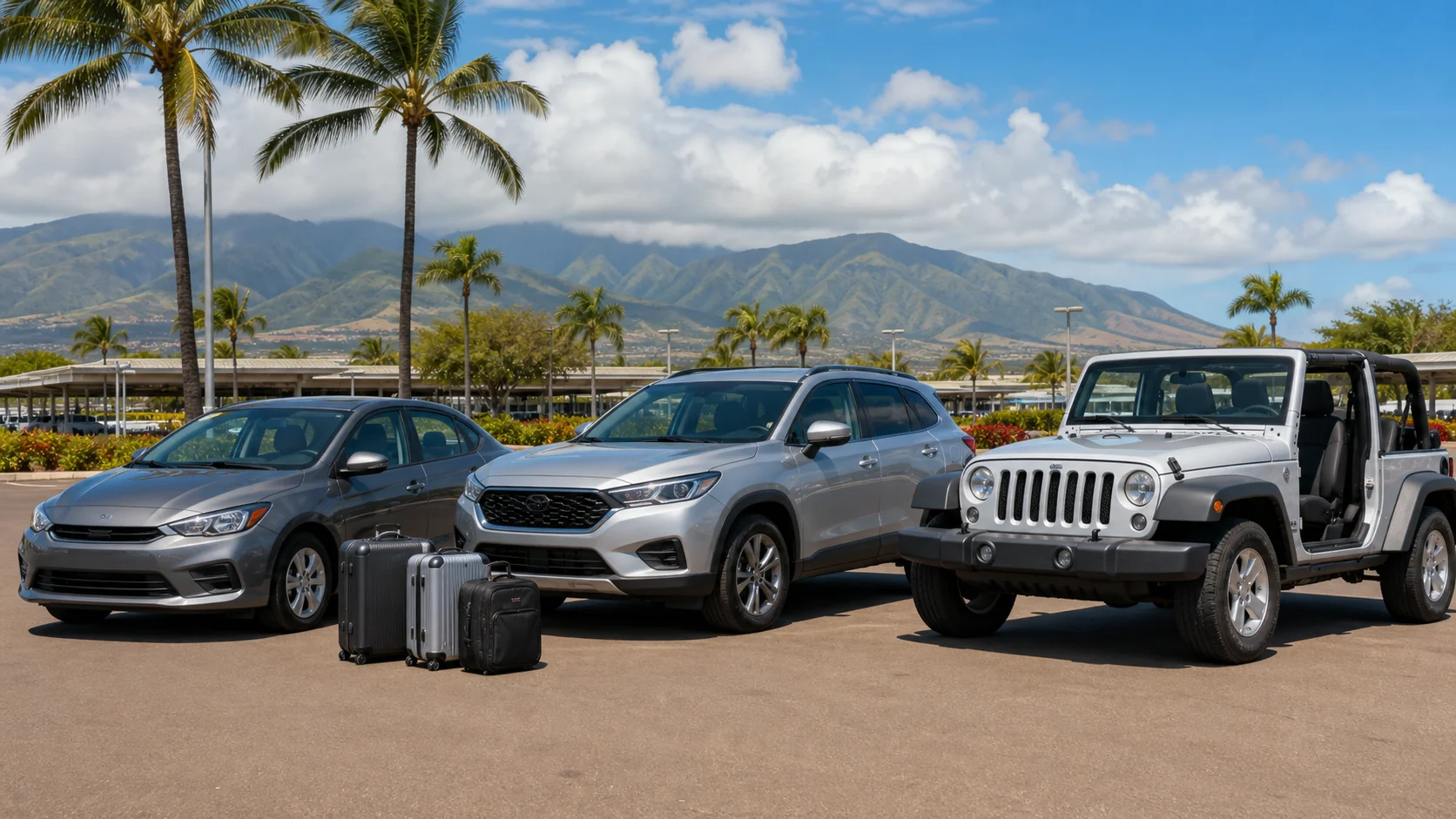
A small car can be the cleanest choice for one or two light packers staying mostly around resort areas. An SUV may be better when luggage, beach gear, groceries, or longer drives are part of the week. A minivan or van can make more sense for families and groups, but larger vehicles may bring tighter parking and different age or coverage questions. A Jeep can be a fun scenic choice, but roof rules, weather, cargo space, and rental restrictions still matter.
Compare the Maui rental car fleet after the renter, credit card, and insurance proof are settled. If you are deciding between a smaller car and a roomier vehicle, ask whether your coverage and the rental policy apply the same way to each class.
A simple pre-trip insurance checklist
Use this before you reserve, then again before you fly:
- The renter’s name matches the license, credit card, reservation, and insurance proof.
- The renter has a valid major credit card, not a debit card.
- The insurance proof shows the coverage the rental company requires.
- The renter understands the deductible and damage responsibility.
- Any additional drivers are approved before they drive.
- Credit card benefit terms have been confirmed directly with the card issuer.
- The vehicle class fits the people, luggage, and Maui routes planned.
- The group knows who to call after an accident, delay, or damage concern.
- The rental policy has been reviewed before pickup day.
Hawaii’s Insurance Division explains that Hawaii is a no-fault state for injuries, while at-fault drivers can still be responsible for vehicle and property damage. It also lists minimum required Hawaii motor vehicle coverages on its motor vehicle insurance information page. Visitors should treat that as background only; your rental agreement, your own policy, and Aloha’s requirements determine what you need to bring.
When to contact Aloha before booking
Contact the local team before reserving if you have no personal auto insurance, only liability coverage, a debit card, a card in someone else’s name, more than one driver, a driver age 21 through 24, a local-renter deposit question, or uncertainty about whether your insurance proof is acceptable. Drivers under 21 are not eligible to rent or be added as drivers.
Aloha Rent A Car is based at 181 Dairy Rd in Kahului, near Kahului Airport, and has served Maui since 1975. The team can help you understand what to bring, but your insurer and card issuer are still the right sources for the details of your own coverage.
When the renter has the required credit card, license, and insurance proof ready, check availability for your Maui dates. If anything about your coverage, card, additional driver, or pickup timing is unclear, contact Aloha Rent A Car before you book.